DC Motors
TYPES OF DC MOTORS
Figure 7a shows an externally-excited DC motor. This type of DC motor is
constructed such that the field is not connected to the armature. This type of DC
motor is not normally used.
Figure 7b shows a shunt DC motor. The motor is called a "shunt" motor because
the field is in parallel, or "shunts" the armature.
Figure 7c shows a series DC motor. The motor field windings for a series motor
are in series with the armature.
Figures 7d and 7e show a compounded DC motor. A compounded DC motor is
constructed so that it contains both a shunt and a series field. Figure 7d is called
a "cumulatively-compounded" DC motor because the shunt and series fields are
aiding one another. Figure 7e is called a "differentially-compounded" DC motor
because the shunt and series field oppose one another.
S h u n t - W o u n d
M o t o r
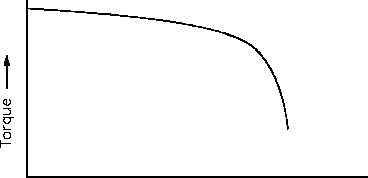
Figure 8 Torque-vs-Speed for a Shunt-Wound DC Motor
Operation
The speed-torque relationship for a
typical shunt-wound motor is
shown in Figure 8.
A shunt-wound DC motor has a
decreasing torque when speed
increases. The decreasing torque-
vs-speed is caused by the armature
resistance
voltage
drop
and
armature reaction. At a value of
speed near 2.5 times the rated
speed, armature reaction becomes
excessive, causing a rapid decrease
in field flux, and a rapid decline in
torque until a stall condition is reached.
Shunt-Wound Motor Applications
The characteristics of a shunt-wound motor give it very good speed regulation, and it is classified
as a constant speed motor, even though the speed does slightly decrease as load is increased.
Shunt-wound motors are used in industrial and automotive applications where precise control of
speed and torque are required.
Rev. 0
Page 9
ES-06