BOILING HEAT TRANSFER
Heat Transfer
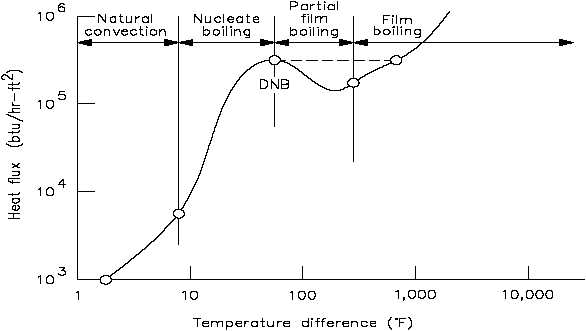
Figure 13 Boiling Heat Transfer Curve
Four regions are represented in Figure 13. The first and second regions show that as heat flux
increases, the temperature difference (surface to fluid) does not change very much. Better heat
transfer occurs during nucleate boiling than during natural convection. As the heat flux increases,
the bubbles become numerous enough that partial film boiling (part of the surface being
blanketed with bubbles) occurs. This region is characterized by an increase in temperature
difference and a decrease in heat flux. The increase in temperature difference thus causes total
film boiling, in which steam completely blankets the heat transfer surface.
Departure from Nucleate Boiling and Critical Heat Flux
In practice, if the heat flux is increased, the transition from nucleate boiling to film boiling occurs
suddenly, and the temperature difference increases rapidly, as shown by the dashed line in the
figure. The point of transition from nucleate boiling to film boiling is called the point of
departure from nucleate boiling, commonly written as DNB. The heat flux associated with DNB
is commonly called the critical heat flux (CHF). In many applications, CHF is an important
parameter.
HT-02
Page 42
Rev. 0